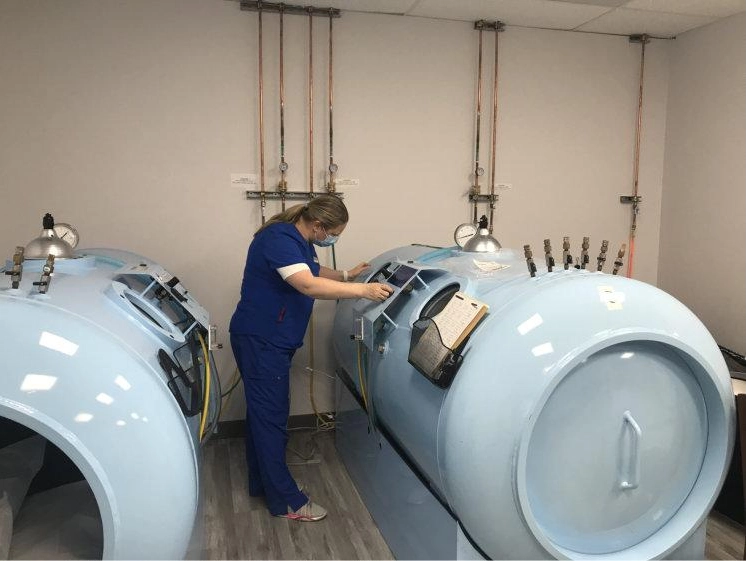
Quick answer: A hyperbaric oxygen chamber for horses is a stall-sized steel pressure vessel, often about 10 feet wide inside. It raises the pressure to 2 or 3 ATA while the horse breathes pure oxygen. To run one safely, though, you’ll need a strong floor, a steady oxygen supply, a code-built fire system, trained staff, and a vet in charge. And budget-wise, plan on a figure that often tops $500,000.
Few pieces of gear in an equine clinic are as big a commitment as a hyperbaric oxygen chamber for horses. For one thing, it weighs about as much as a loaded truck. It also needs its own oxygen supply and its own fire plan. And it only does any good when the people running it really know the job.
We build the PCCI 1200E equine chamber here at PCCI Hyperbaric Systems, so vets, rehab centers, and breeding farms bring us the same handful of questions over and over. How much room does it take? Oxygen or air? Is it safe? What will it actually cost? So this guide works through each one.
What Is a Hyperbaric Oxygen Chamber for Horses?
A hyperbaric oxygen chamber for horses is a large, sealed metal capsule used to deliver 100% pure oxygen at higher-than-normal atmospheric pressure (2 to 3 atmospheres absolute, or ATA)
Pressure here is measured in ATA, which stands for atmospheres absolute. For example, at sea level, you’re sitting at 1 ATA right now. Equine HBOT, by comparison, usually runs at 2 to 3 ATA, which is roughly what a diver feels at 33 to 66 feet down.
How Does Equine Hyperbaric Oxygen Therapy Work?
Equine Hyperbaric Oxygen Therapy (HBOT) works by placing a horse inside a specialized, sealed steel chamber where it breathes 100% pure oxygen under increased atmospheric pressure.
Normally, an animal’s red blood cells carry oxygen through the body, and these cells are already nearly fully saturated under normal conditions. By elevating the barometric pressure inside the chamber, the therapy utilizes basic gas laws to force pure oxygen directly into the blood plasma (the liquid part of the blood) and body tissues. This creates a “supersaturated” state of oxygenation that bypasses restricted or damaged blood vessels to accelerate healing from the inside out
That’s exactly why vets turn to equine HBOT to support healing and fight certain infections, especially those caused by anaerobic bacteria, the germs that can’t stand oxygen. Keep in mind, however, that HBOT is an add-on. So it works alongside surgery, wound care, and medication, never in place of them.
What Happens During a Session?
In practice, a session inside a hyperbaric oxygen chamber for horses has three stages:
- Pressurize: The pressure rises slowly to the treatment level. On our 1200E, for example, staff can set the rate anywhere from 0 to 3 psi per minute.
- Treat: The horse stays at pressure, often for about 45 to 60 minutes.
- Depressurize: Staff then bring the pressure back down slowly.
Most horses walk in calmly, and some even doze off once they settle. A light sedative is common for the first few visits, while the horse gets used to the sounds and the space.
What Conditions Is HBOT Used For in Horses?
Vets use the chamber for a surprisingly wide range of cases. Still, these are the ones we hear about most:
Area | Typical cases |
Wounds | Large or slow-healing wounds, skin grafts, crush injuries |
Infections | Bone infections (osteomyelitis), joint infections in foals, deep or anaerobic infections |
Hooves and soft tissue | Laminitis, tendon and ligament injuries |
Surgery recovery | Support after colic surgery and other procedures |
Foals and mares | Foals with low oxygen at birth, mares after foaling |
Airways and nerves | Smoke inhalation, some nerve and brain injuries |
What Does the Research Actually Show?
We’d rather give you the honest picture than a sales pitch. Well-controlled studies in horses are still rare, so much of what vets know comes from human medicine and case reports. For now, then, think of chamber time as supportive care, not a guaranteed cure.
A few findings do stand out, though:
- In foals with advanced bone infection, a 2002 University of Kentucky study reported less swelling and lameness.
- A 2008 study, by contrast, found no benefit for skin grafts that were already healing well. In other words, HBOT seems to help most when tissue is struggling.
- In healthy horses, meanwhile, University of Calgary research found HBOT did not raise lung inflammation, and blood oxygen fell back to normal within minutes of leaving the chamber.
- Later, the same Calgary researcher rated the evidence as strongest for deep and anaerobic infections and as weak for athletic recovery.
What Does a Hyperbaric Oxygen Chamber for Horses Look Like Inside?
Most equine chambers share the same basic layout. So here’s what you’ll find in our 1200E, as an example:
- Inside size: A 10-foot diameter, with a ceiling a little over 9 feet high
- Main door: 84 x 40 inches, wide enough for a calm walk-in
- Second access: A 24 x 18 inch manway for staff
- Walls: Thick steel, lined with fire-resistant, oxygen-rated padding that also stands up to kicks
- Windows: Four code-compliant viewports, plus a multi-angle camera system
- Lighting: LED lights mounted outside the chamber, so no wiring sits inside
- Comfort: Noise mufflers and a mist system that keeps humidity up
That mist system earns its place twice over, because it also cuts static build-up, which matters a great deal in an oxygen-rich space.
Pure Oxygen vs. Air with a Mask: Which Setup Fits Your Facility?
There are two ways to get oxygen to the horse, and because of that, the choice affects your oxygen bill, your fire risk, and your daily routine.
Pure oxygen chamber | Air chamber with BIBS mask | |
How it works | The whole chamber fills with oxygen | The chamber fills with air, and the horse breathes oxygen through a mask |
Oxygen use | High | Much lower |
Fire risk | Higher | Lower, since the room holds normal air |
Horse prep | No mask | The horse must accept a mask |
Best for | Facilities running standard protocols | Facilities that want lower oxygen costs and extra safety margin |
We build both. First, the 1200E-O fills with pure oxygen. The 1200E air model, on the other hand, uses our own constant-flow BIBS mask (BIBS stands for built-in breathing system), which adjusts the oxygen flow on its own as pressure changes. It also runs off a standard 50 psig hospital oxygen supply, and real-time oxygen analysis is built in as well.
Horse Hyperbaric Chamber Safety: What Every Facility Must Plan For
Oxygen makes a fire burn faster and hotter, and that’s the biggest risk with any equine chamber. And it isn’t a theoretical one, either. In February 2012, an explosion at an equine rehab center in Ocala, Florida, killed a worker and a horse, and reports at the time pointed to a spark inside the high-oxygen chamber.
So safety has to live in three places at once: the chamber, the room, and the daily routine.
Fire Safety Built Into the Chamber
First, NFPA 99 is the main US fire code for health care settings, and Chapter 14 covers hyperbaric chambers. It also classifies animal chambers as “Class C.” So in a Class C hyperbaric oxygen chamber for horses, you should look for:
- A deluge fire suppression system
- No electrical equipment inside the chamber
- Automatic pressure release when the deluge fires
- A high-flow relief valve to stop over-pressure
- Manual backup controls for every key safety function
Of course, our 1200E covers each of those. Its deluge also has a bypass, so staff can test it without soaking the interior. And on the air model, the mask switches to a backup gas when the deluge fires.
How to Prepare a Horse for Each Session
Still, daily habits matter every bit as much as the hardware. So before each session, staff should:
- Pull the shoes, since a shod hoof can strike a spark on metal
- Remove the halter and any metal tack
- Skip oil-based ointments and creams
- Lightly dampen the coat to cut static, if the chamber has no mist system
- Get a vet check first, especially for any breathing problems
A vet should also screen every horse before its very first session. Untreated air around the lungs (pneumothorax), for example, is a common reason to hold off.
Other Risks to Watch
Pressure changes can also strain the ears, sinuses, and lungs, which is why staff raise and lower the pressure slowly. In rare cases, too much oxygen can affect the brain or lungs. And because the horse is sealed inside, someone has to watch it the whole time through the windows and cameras.
Planning an Equine Hyperbaric Room?
Floor loads, oxygen lines, and fire code all need to line up before the chamber arrives. So talk with a PCCI engineer about the 1200E and what your site needs.
Equine Hyperbaric Facility Requirements
Surprisingly, here’s where a lot of projects stumble. The chamber is only half the job, because the building has to be ready for it.
Space, Floor and Building Needs
Our 1200E weighs about 14,500 pounds when rated at 3 ATA, and it stands about 12 feet tall overall. That means your facility needs:
- A floor slab rated for that weight
- Ceiling height well above 12 feet, plus room to rig the chamber into place
- A clear path to the 84 x 40 inch door, so horses can walk straight in
- Space around the chamber for the control console and staff
Oxygen, Air and Utilities
Gas supply comes next. For instance, a pure oxygen chamber needs a large, steady oxygen supply. An air chamber, meanwhile, needs compressed air for pressure plus a 50 psig oxygen line for the mask. You’ll also need power for the controls outside the chamber, along with deluge water and a safe place to vent exhaust gas.
Permits and Inspections
In most areas, local building and fire officials review the project before you treat a single horse. Then they’ll typically check it against NFPA 99 and local codes. For that reason, bring a chamber engineer in before your plans are final. Changes made after the slab is pour ed cost far more, so it pays to plan early.
Staffing and Training for an Equine Hyperbaric Program
After all, a hyperbaric oxygen chamber for horses is only as safe as the people running it. So at a minimum, your program needs:
- A veterinarian in charge, who decides which horses get HBOT and sets each protocol.
- Trained chamber operators. Many facilities, for example, look for hyperbaric technologists certified by the NBDHMT.
- Hands-on chamber training, because staff needs to know your exact model, not just general HBOT theory.
- Written emergency steps that cover fire, a panicked horse, and a fast pressure drop.
When we install a chamber, we also train your operators on site. That training then covers the controls, gas supply, safety checks, troubleshooting, and emergency response.
How Much Does a Hyperbaric Oxygen Chamber for Horses Cost?
Generally, equine chambers are large, heavy and expensive to build. A 2015 industry report put the average price of a hyperbaric oxygen chamber for horses at about $500,000, and freight, rigging, and site work come on top of that.
What Drives the Total Cost
- Chamber size and pressure rating
- Pure oxygen vs. air with a mask
- Controls, cameras, and fire systems
- Building upgrades, such as the slab, ceiling and gas lines
- Oxygen use over the chamber’s life
- Training, upkeep and window inspections
An air chamber with a mask often costs less to run, simply because it uses far less oxygen.
What Do Facilities Charge per Session?
Naturally, session prices vary a lot by region. For example, the same 2015 report listed one facility at $275 per session, with a 10-session minimum. So a chamber that runs several times a week can build steady income, but you should still run the numbers on your own caseload first.
Keeping an Equine Chamber in Service
With good care, though, a hyperbaric oxygen chamber for horses can stay in use for decades. Routine care generally includes:
- Preventative maintenance, at least once a year for most facilities
- Acrylic window and seal checks under ASME PVHO-2
- Deluge system tests
- Control and gas system checks
Also, if you already own an older chamber, a facility evaluation can show what needs fixing to meet current code.
How PCCI Builds the 1200E Equine Chamber
We design and build our hyperbaric oxygen chamber for horses, the 1200E, in the USA. Plus, it’s built to ASME Section VIII, Division 1, and ASME PVHO-1, with fire suppression designed to NFPA 99, Chapter 14, Class C. We make it under an ISO 9001:2015 quality system, then test it at the factory and again on site.
We can also configure it for dromedaries (camels) and other large animals. In addition, our division head, Ramesh Dixit, PE, sits on ASME PVHO, NFPA, and UHMS safety committees. You can read more about PCCI and the standards work behind our chambers, or browse the other applications we serve.
To be clear about our role, though: we build, install, and service chambers. We don’t treat horses. Instead, your vet decides whether HBOT is right for each patient.
Frequently Asked Questions
How much does one hour in a hyperbaric chamber cost for a horse?
Prices vary by region and facility. For example, one 2015 report listed $275 per session, and most sessions run about 45 to 60 minutes at pressure. Many facilities also sell treatment as a package of several sessions, so ask your vet or the facility for a written price before you start.
What are the downsides of hyperbaric oxygen therapy for horses?
The main downsides, in short, are cost, limited access, and real safety risks. Few facilities have an equine chamber, so you may have to travel. Pressure can also strain the ears and lungs. Fire, however, is the most serious risk, which is why shoes, metal, and oily products must stay out.
Is it legal to own a hyperbaric chamber for horses?
Yes, in general. Installing one, however, usually needs approval from local building and fire officials, who review the chamber and room against NFPA 99 and local codes. Then your engineer supplies the technical details for that review. A vet should still direct every treatment, so check your state and local rules before you buy.
How many HBOT sessions does a horse need?
It depends on the problem and on how the horse responds, so there’s no fixed number. A short course may be just a handful of sessions, while serious cases can take much longer. Some facilities, for instance, sell packages of 10. Either way, the vet sets the plan and adjusts it as healing progresses.
Do horses need sedation in a hyperbaric chamber?
Usually only at first. Many horses get light sedation for their first few sessions while they learn the routine. After that, most stand calmly, and some even fall asleep. Calm handling and a quiet room help too, but the vet makes the call on sedation for each horse.
How big is a hyperbaric oxygen chamber for horses?
In general, single-horse chambers are often about 10 feet wide inside. At PCCI, our 1200E has a 10-foot diameter interior, a ceiling just over 9 feet, and an 84 x 40 inch door. It also weighs about 14,500 pounds, so the floor must be built to carry it.