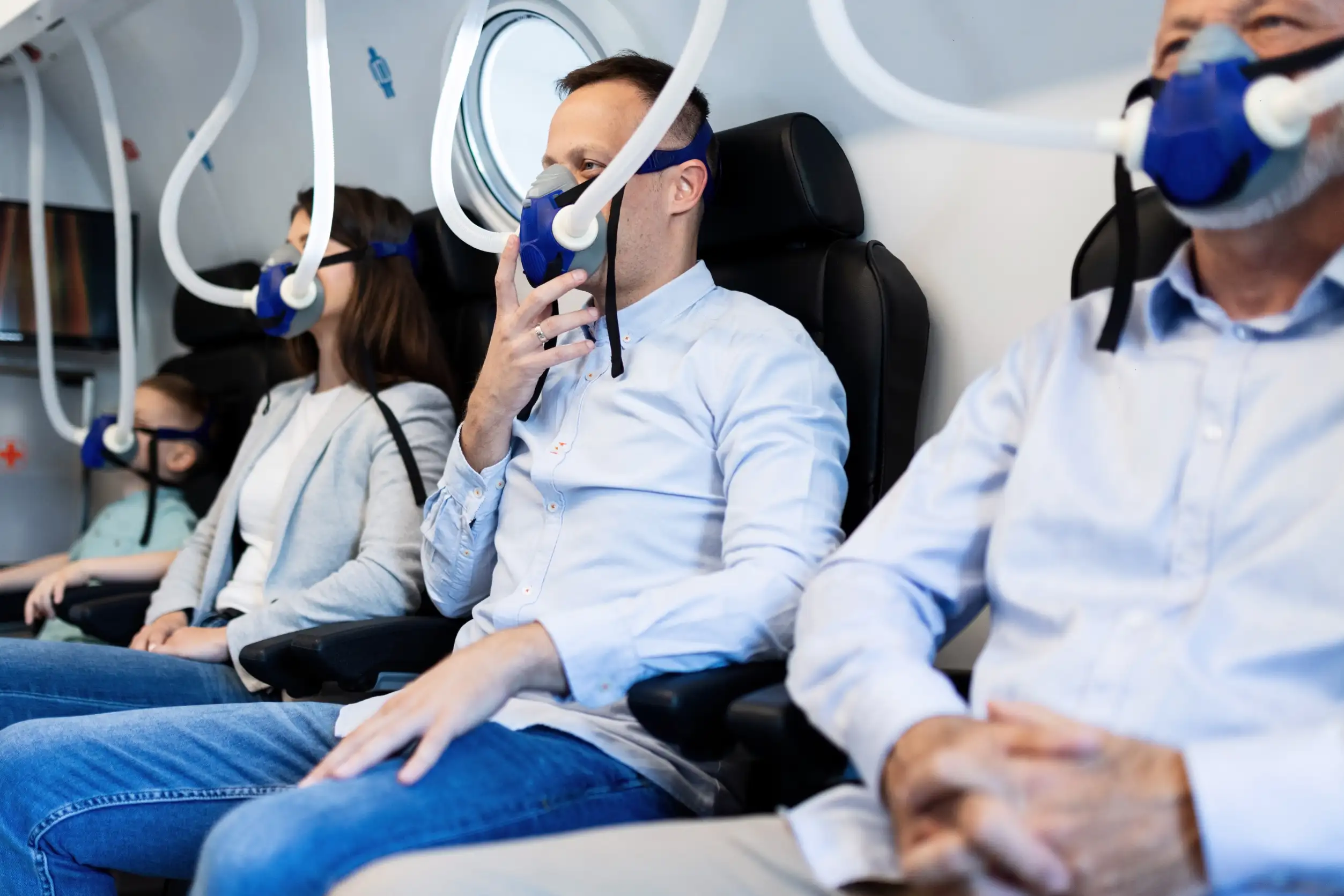
Quick answer: An altitude chamber is a sealed steel room that lowers the air pressure inside. As a result, it copies the thin air of high altitude. Pilots and aircrew then train in one to feel their own hypoxia signs, practice with oxygen masks, and rehearse a rapid decompression. Trained staff watch the whole time. So when it counts, crews can spot the warning signs fast in a real aircraft.
Ask pilots about their first altitude chamber flight, and many recall the same moment. They tried simple math with their mask off, and yet failed without noticing. That’s the whole point, because hypoxia, or a lack of oxygen, dulls the mind quietly. So the safest place to meet it is on the ground.
At PCCI Hyperbaric Systems, we design and build hypobaric altitude chambers for military and aerospace training. This guide, then, explains how an altitude chamber works and what happens in a session. It also shows how it differs from other altitude systems.
What Is an Altitude Chamber?
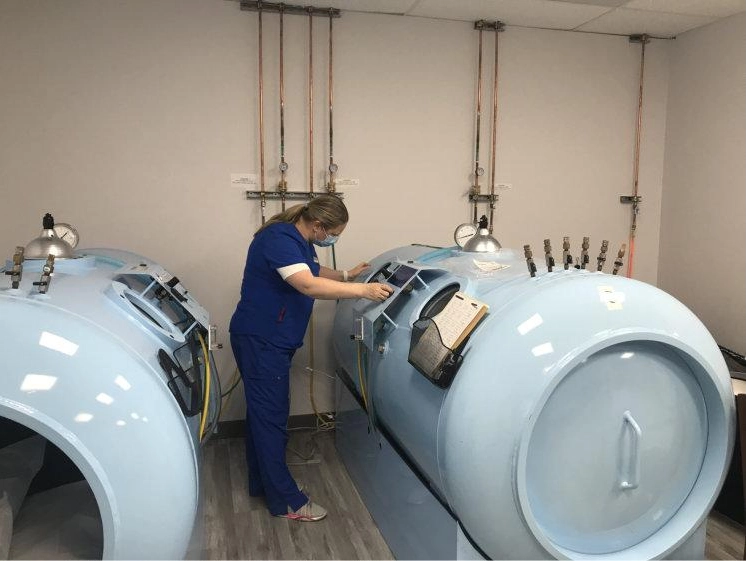
A hypobaric altitude chamber holds people at a pressure lower than the air outside. “Hypo” means below, and “baric” means pressure. So vacuum pumps pull air out until the inside matches a set height, such as 25,000 feet. People sit inside, too. That makes it a pressure vessel for human occupancy (PVHO), just like a hyperbaric chamber.
What Is the Purpose of Altitude Chamber Training?
The main goal is hypoxia recognition, because each person reacts to low oxygen in their own way. So altitude chamber training lets pilots learn their personal early signs in a safe, supervised setting. It also teaches them to use oxygen gear and to act fast after a pressure loss.
Who Uses Altitude Chambers?
Mostly, military aircrew, aerospace researchers, and aviation schools use them. Some universities also run aviation physiology courses in them. Research teams also use them to study how people and gear behave in thin air.
How Does an Altitude Chamber Work?
As you climb, the air above you weighs less, so air pressure drops. An altitude chamber copies that drop. First, the doors seal, and then pumps remove air until the inside matches the target height.
Barometric Pressure vs. Oxygen Partial Pressure
However, here’s a point many guides get wrong. Air at 25,000 feet is still about 21% oxygen, just like at sea level. Instead, what changes is the push behind that oxygen, called the oxygen partial pressure (PO2). In fact, the FAA says altitude hypoxia comes mainly from this drop. In other words, it doesn’t come from less oxygen in the mix.
Altitude | Air pressure | Oxygen partial pressure (PO2) |
Sea level | 760 mmHg (14.7 psi) | About 159 mmHg |
5,000 ft | 632 mmHg (12.2 psi) | About 132 mmHg |
10,000 ft | 523 mmHg (10.1 psi) | About 109 mmHg |
18,000 ft | 379 mmHg (7.3 psi) | About 79 mmHg |
25,000 ft | 282 mmHg (5.5 psi) | About 59 mmHg |
35,000 ft | 179 mmHg (3.5 psi) | About 37 mmHg |
So at 18,000 feet, you get only about half the oxygen pressure of sea level. That’s why a hypobaric chamber feels so real. After all, the body faces the same physics as in flight.
How Vacuum Pumps and Pressure Controls Work
First, a vacuum pump system pulls air out of the chamber. Meanwhile, valves let air back in to hold pressure or to “descend.” Sensors also track pressure, oxygen, heat, and airflow.
Simulated Altitude, Ascent Rate and Exposure Duration
Before each run, operators set a “flight profile”: how high to go, how fast to climb, and how long to stay. For example, a session might climb at a steady rate, hold for hypoxia training, then descend. So each step is planned ahead and logged.
How Is an Altitude Chamber Used for Pilot Training?
In practice, a typical supervised session follows six steps. However, this is never something to try alone or without trained staff.
Pre-Training Medical Checks and Safety Briefing
First, each trainee gets a medical screen. For example, a cold, an ear or sinus problem, or some heart or lung issues can rule a person out. Then instructors explain the plan, the hand signals, and the emergency steps.
Oxygen Mask Fitting and Equipment Familiarization
Next, each trainee gets a fitted oxygen mask and learns the regulator. For higher profiles, trainees also pre-breathe pure oxygen first. This step, called denitrogenation, also lowers the risk of decompression sickness.
Controlled Ascent to Simulated Altitude
Then the chamber “climbs.” On the way up, trainees clear their ears, because trapped gas grows as pressure falls.
Recognizing Hypoxia Symptoms During Training
At a set height, trainees remove their masks under close watch. Then they write, do simple tasks, and note how they feel. In fact, most people are surprised by how fast their skills slip, and how little they notice it.
Supplemental Oxygen and Emergency Recovery Procedures
After a short time, instructors tell trainees to put their masks back on, and recovery is usually quick. Some programs also run a rapid decompression drill. Here, then, the pressure drops fast to copy a cabin failure.
Post-Training Review and Hypoxia Awareness
Finally, the chamber descends slowly, and the group reviews what each person felt. Many trainees also keep a note of their own symptoms for future flights.
Building or upgrading an altitude training program?
After all, pressure profiles, controls, and safety systems all shape how well your chamber trains crews. So talk with our engineers about an altitude chamber built for your mission.
What Happens to the Human Body Inside an Altitude Chamber?
Low Oxygen Pressure Affects the Brain and Body
First, with less oxygen pressure, less oxygen reaches the blood. The brain feels it first, because it uses so much oxygen. As a result, judgment, memory, and coordination start to slip, often before the person notices.
Common Signs and Symptoms of Hypoxia
Type | Common signs |
What others may see | Faster breathing, bluish lips or nails, poor coordination, slow responses |
What you may feel | Headache, dizziness, tingling, warmth, tiredness, blurred or tunnel vision |
What changes inside | Poor judgment, false confidence or euphoria, confusion, trouble with simple tasks |
Symptoms vary from person to person. Hyperventilation, meanwhile, can cause similar tingling and dizziness. So personal symptom training matters a great deal.
What Is Time of Useful Consciousness (TUC)?
Time of useful consciousness is how long a person can still act usefully without extra oxygen. According to FAA guidance, the average TUC is roughly:
Altitude | Average TUC |
18,000 ft | 20 to 30 minutes |
22,000 ft | 10 minutes |
25,000 ft | 3 to 5 minutes |
30,000 ft | 1 to 2 minutes |
35,000 ft | 30 to 60 seconds |
40,000 ft | 15 to 20 seconds |
However, these are averages, not a countdown, since fitness, smoking, health, and activity all change them. And after a rapid decompression, TUC can drop by up to half.
How Altitude Affects Judgment, Vision and Coordination
Vision often goes first. In fact, the FAA notes that night vision can start to fade as low as 5,000 feet. Meanwhile, judgment and hand-eye control slip, and people often feel falsely sure of themselves.
Barotrauma and Decompression Sickness Risks
Pressure changes can also hurt the ears and sinuses, which is called barotrauma. In addition, nitrogen can bubble out of the blood at high altitudes. That’s called decompression sickness (DCS). So pre-breathing oxygen and slow pressure changes help lower these risks.
What Are the Main Uses of Altitude Chambers?
Military Pilot and Aircrew Training
Military aviation is the main user. So aircrew train to spot hypoxia, use oxygen systems, handle a rapid decompression, and test pressure suits. Night vision effects are often part of the course, too.
Civil Aviation Hypoxia Awareness Training
Civil pilots can also take altitude physiology courses. The FAA has long offered training on hypoxia, oxygen gear, and decompression. Some courses now use normobaric (normal pressure) setups instead of a pressure chamber.
Rapid Decompression and Cabin Pressure Training
For this, a hypobaric chamber can drop pressure fast to copy a cabin failure. So crews learn how it sounds, feels, and looks before they face it in flight. That even includes the sudden fog that can form.
Aerospace Physiology and Medical Research
Researchers also use altitude chambers to study human limits and test gear at low pressure. Some universities, too, run aviation physiology courses in them.
Athletic Altitude Training and Acclimatization Research
Some athletes and sports labs also use low-pressure or low-oxygen rooms to study altitude effects. However, most sports “altitude rooms” are normobaric systems, not pressure chambers, as explained below.
Hypobaric vs. Normobaric Altitude Training: What’s the Difference?
A hypobaric chamber pulls air out, so total pressure drops. Oxygen still makes up about 20.9% of the air, but its partial pressure falls.
How Normobaric Systems Reduce Oxygen Concentration
A normobaric hypoxic system, by contrast, keeps normal pressure. Instead, it lowers the share of oxygen in the air, often by mixing in nitrogen. For example, hypoxic tents and reduced-oxygen masks work this way.
Which Method Can Simulate Pressure Changes?
Only a hypobaric chamber can copy real pressure changes, such as ear blocks, gas growth, or a rapid decompression.
Differences in Training Goals, Equipment and Risks
Feature | Hypobaric chamber | Normobaric hypoxic system |
Air pressure | Reduced | Stays near normal |
Oxygen share of air | Stays near 20.9% | Reduced |
Oxygen partial pressure | Reduced | Reduced |
Copies pressure changes | Yes | No |
Hypoxia training | Yes | Yes |
Rapid decompression drill | Yes, with the right gear and plan | No real pressure loss |
Decompression sickness risk | Possible at high profiles | Very low |
In short, both can teach hypoxia. Only a hypobaric altitude chamber, though, can train crews for the pressure side of flight.
Altitude Chamber vs. Hyperbaric Chamber: What’s the Difference?
Hypobaric Chambers Simulate Reduced Pressure
An altitude chamber lowers pressure below sea level to copy flight.
Hyperbaric Chambers Create Increased Pressure
A hyperbaric chamber, on the other hand, raises pressure above sea level, often to 2 or 3 times normal.
Different Applications in Aviation Training and Hyperbaric Medicine
So altitude chambers train aircrews and support research, while hyperbaric chambers treat patients and divers. Both, however, are built to the same safety standard, ASME PVHO-1.
Is Altitude Chamber Training Safe?
Altitude chamber training is safe when it’s well run, but it isn’t risk-free.
Medical Screening and Participant Eligibility
Every trainee should pass a medical screen first. For instance, a cold, a recent dive or some health problems can rule a person out.
Instructor Supervision and Physiological Monitoring
Then trained staff watch every trainee, often with pulse oximeters that track blood oxygen (SpO2). Inside observers may also ride along on their own oxygen.
Oxygen Supply, Communication and Emergency Systems
The chamber also needs a steady oxygen supply, clear two-way voice links, and emergency repressurization. That way, staff can bring pressure up fast if someone gets into trouble.
Risks of Hypoxia, Barotrauma and Decompression Sickness
The main risks are deep hypoxia, ear or sinus injury, and decompression sickness. Still, good screening, slow pressure changes, oxygen pre-breathing and close monitoring keep them low.
Why Altitude Training Requires Qualified Personnel
Hypoxia hides itself, so trainees can’t judge their own safety. That’s why every session needs a qualified supervisor, a safety observer, and a written plan.
What Equipment and Features Does an Altitude Training Chamber Need?
Feature | What it controls | Why it matters |
Vacuum and pressure control | How high and how fast the chamber “climbs” | Smooth, repeatable profiles |
Flight profile controls | Set altitude, rates and hold times | Consistent training and research |
Oxygen supply and monitors | Oxygen to masks and room checks | Trainee safety and recovery |
Environmental monitoring | Pressure, temperature and airflow | Comfort and accurate data |
Occupancy and locks | How many people train at once | Class size and staff access |
Windows and cameras | View of every trainee | Fast response to problems |
Two-way communication | Voice link to instructors | Clear commands and calm |
Emergency repressurization | Fast return to safe pressure | Core safety backstop |
Data recording | Logs of pressure and readings | Records, review and research |
PVHO-1 construction | Vessel design and testing | Safe, code-built structure |
In addition, NFPA 99B covers fire safety for hypobaric facilities. So buyers should check both the vessel standard and the facility code.
How Does PCCI Support Hypobaric Altitude Training Programs?
Custom Altitude Chamber Design and Engineering
First, we design and build the ATR Series of hypobaric altitude chambers, in 6-, 12- and 16-person models. Each one also comes in a round or rectangular layout, built to the training need.
Military and Aerospace Training Applications
Today, our chambers support aircrew training in hypoxia, rapid decompression, night vision, oxygen systems, voice links, and pressure suits. They also support aerospace research. For example, the University of North Dakota trains with a 12-person ATR chamber. The Bangladesh Air Force, meanwhile, uses a 6-person ATR chamber in Dhaka.
Pressure Controls, Instrumentation and Safety Systems
Our hypobaric altitude chambers run in automatic, semi-automatic, or manual mode. Each lock also has its own touchscreen for flight profiles, and a camera system records every session.
Installation, Testing and Long-Term Support
We also install, test, and support every chamber, with a one-year parts and labor warranty. Note, though, that we build the chamber, while training programs and their instructors run the courses.
Frequently Asked Questions
What is an altitude chamber used for?
An altitude chamber mainly trains pilots and aircrew. They learn to spot hypoxia, use oxygen gear, and handle a rapid decompression. It also supports aerospace research and aviation physiology courses. Some labs also use altitude chambers to study how people and gear behave at low pressure.
How does an altitude chamber simulate high altitude?
First, vacuum pumps pull air out of the sealed chamber. So the pressure inside drops to match a set height. The air stays about 21% oxygen, but its pressure falls. As a result, the body takes in less oxygen, just as it would in flight at that altitude.
What is the difference between hypobaric and hyperbaric chambers?
A hypobaric chamber lowers pressure below sea level to copy high altitude. A hyperbaric chamber, by contrast, raises pressure above sea level, often to 2 or 3 times normal. So it’s used for medical care or diving instead. Both hold people, so both are built to ASME PVHO-1.
How does altitude chamber training help pilots?
It lets pilots feel their own hypoxia symptoms safely, before they meet them in flight. They also practice with oxygen masks and rapid decompression. So if oxygen runs low in flight, they can spot the signs and act in time.
What happens during hypoxia awareness training?
After a medical check and briefing, trainees put on masks, and the chamber climbs. Then, at a set height, they remove their masks under close watch and do simple tasks. Then they put the masks back on, recover, descend, and review their personal symptoms with instructors.
What altitude can a training chamber simulate?
It depends on the chamber’s design and the training plan, so there’s no single number. Many aircrew courses train at heights around 25,000 feet, while some research profiles go much higher. Each chamber has its own rated limits, so the training program sets heights within them.
What are the risks of altitude chamber training?
The main risks are deep hypoxia, ear and sinus injury, and decompression sickness. However, medical screening, slow pressure changes, oxygen pre-breathing and trained supervisors keep these risks low. So training should never happen without qualified staff and a written safety plan.
Do pilots have to complete altitude chamber training?
Not all of them. In the US, pilots of pressurized aircraft that fly above 25,000 feet need high-altitude ground training under 14 CFR 61.31(g). But that rule doesn’t require a chamber flight. Military aircrew, by contrast, usually complete physiology training set by their own service.
Can athletes use altitude chambers for training?
Some athletes and sports labs do use them, mostly for research and acclimatization studies. However, most sports “altitude rooms” and tents are normobaric systems that lower oxygen, not pressure. True hypobaric chambers, by contrast, are mainly used for aviation training and research.
What is the difference between an altitude chamber and a hypoxic tent?
First, an altitude chamber lowers the actual air pressure. A hypoxic tent, by contrast, keeps normal pressure and lowers the share of oxygen in the air instead. Both can cause hypoxia, but only the chamber can copy pressure changes like ear blocks or rapid decompression.