
Quick Answer: The hard shell vs. soft shell hyperbaric chamber question comes down to one number first: pressure. Hard shell hyperbaric chambers are rigid steel or acrylic vessels built to ASME PVHO-1 and NFPA 99. They run at 2.0 to 6.0 ATA and are FDA 510(k) cleared for 13 medical uses, including decompression sickness and diabetic wounds. Meanwhile, Soft shell hyperbaric chambers are inflatable nylon or TPU bags pressurized with air to about 1.3 ATA, and are FDA cleared only for acute mountain sickness. That gap decides which FDA-cleared conditions a chamber can treat, which fire and building codes apply, and how long the equipment lasts.
We design and build hard shell chambers at PCCI Hyperbaric Systems, and we do not refurbish, sell, or service soft-shell or portable hyperbaric chambers. This article explains where soft-shell chambers fit, how they differ from rigid hard-shell systems, and where PCCI’s hard-shell expertise applies. Regulatory and standards-related claims are supported by the named sources provided in the reference section.
Hard Shell vs. Soft Shell Hyperbaric Chamber at a Glance
Attribute
Soft shell hyperbaric chamber
Hard shell hyperbaric chamber
Construction
Fabric (nylon, TPU or PVC) with zippers
Steel, aluminum or acrylic rigid vessel
Typical pressure
Below 1.4 ATA, usually about 1.3 ATA
Typically 2.0 to 3.0 ATA for monoplace chambers; multiplace chambers rated to 6 ATA
Breathing gas
Compressed room air (FDA clearance bars supplemental oxygen)
Typically, nearly 100% medical oxygen is used to pressurize monoplace chambers, or the patient breathes oxygen through a hood or mask when the chamber is pressurized with ai
FDA 510(k) clearance
Acute mountain sickness only
UHMS approved list of 13 medical indications
UHMS indications
None met
Typically these chambers are designed to accommodate treatment for most of the UHMS approved indications.
Governing codes
Often unclear in practice
ASME PVHO-1, ASME Section VIII, Div. 1, NFPA 99 Chapter 14, FDA GMP
Occupancy
Typically one person
One person (monoplace) or 2 to 30 (multiplace) persons
Portability
Deflates, fits in a car
Fixed install, or container/trailer-mounted
Service life
Not defined by any standard
Decades with PVHO-2 in-service inspections
How Soft Shell and Hard Shell Hyperbaric Chambers Are Built
Soft shell hyperbaric chambers: fabric, zippers and a compressor
Soft shell hyperbaric chambers are reinforced fabric envelopes, usually nylon, polyurethane (TPU) or PVC. A zipper closes the entry, and an external compressor pushes air in to inflate the bag and hold pressure. When the compressor stops, the chamber slowly loses pressure.
The design traces back to the Gamow bag, a portable bag for climbers with altitude sickness. Because of that lineage, soft shells cleared by the FDA were cleared as equivalent to that device. Their indication is acute mountain sickness, and the UHMS notes they are designed to be compressed with air only. These types of chambers are not cleared by FDA or considered suitable to treat medical indications.
Hard shell hyperbaric chambers: rigid vessels built to comply with ASME PVHO-1, NFPA 99 and FDA GMP design/fabrication requirements.
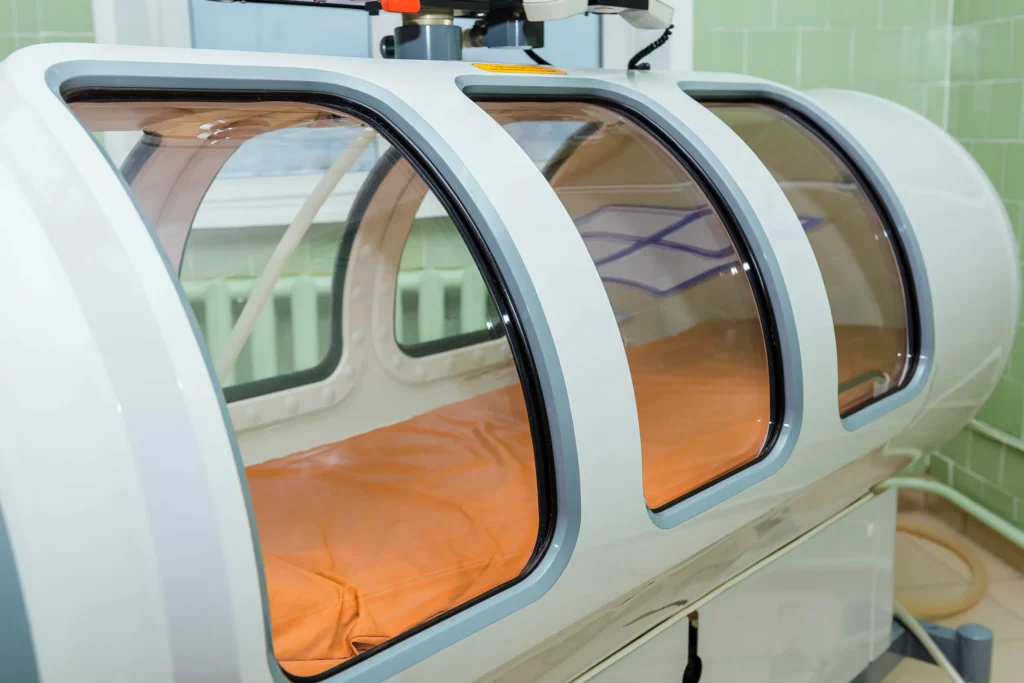
A hard-shell hyperbaric chamber is typically a welded or formed pressure vessel. The chamber shell is constructed of steel, aluminum, or acrylic, and the shell and viewports are made of acrylic rated in accordance with ASME PVHO-1, the Safety Standard for Pressure Vessels for Human Occupancy. Patient entry is through a sealed door, not a zipper. In our multiplace chambers, the internal pressure seals the doors, eliminating the need for mechanical latches that can be prone to failure.
One detail rarely mentioned in this comparison is where PVHO-1 boundary starts. The standard applies to any vessel enclosing a person above 2 psig, or 1.14 ATA. A soft shell at 1.3 ATA runs at about 4.4 psig. In other words, it operates inside the range PVHO-1 covers, without being built as a PVHO-1 vessel. The UHMS raises the same point in its position statement on fabric chambers.
Hard shell is a family, not one product
Comparisons usually treat “hard shell” as one category. In practice, buyers choose between several designs:
- Oxygen-filled monoplace. One patient, the whole vessel filled with 100% oxygen. NFPA 99 calls this a Class B chamber.
- Air-pressurized monoplace. One patient, chamber filled with air, oxygen by hood or mask. Our air-pressurized Althea 4200 works this way, seats the patient upright and fits a 48-inch doorway.
- Several patients plus an inside attendant, pressurized with air, oxygen through built-in breathing systems (BIBS). These are Class A chambers. Our multiplace hyperbaric chambers seat 2 to 30 people with Single, Dual or Triple Locks.
- Class C chambers for animals. Our equine hyperbaric chamber, the 1200E, has a 10 ft diameter and is built to human-occupancy codes anyway.
- Personal “mild” hard shells. Rigid units sold for home use at roughly 1.3 to 2.0 ATA. A rigid wall alone does not make these medical devices, so check their FDA status and code documents as you would any chamber.
Pressure: Why 1.3 ATA and 2.0 ATA Are Not Close
Pressure matters because of Henry’s law. The amount of a gas that dissolves in a liquid rises with that gas’s partial pressure. So, in hyperbaric oxygen therapy, both the chamber pressure and the oxygen percentage you breathe set how much oxygen reaches your plasma.
The oxygen math, scenario by scenario
Inspired oxygen pressure equals the oxygen fraction times the absolute pressure (Dalton’s law). Here is what the lungs receive in six common setups:
Scenario | Pressure | Oxygen breathed | Inspired oxygen pressure |
Room air at sea level | 1.0 ATA | 21% | 160 mmHg |
Soft shell on air | 1.3 ATA | 21% | 207 mmHg |
Oxygen mask at sea level | 1.0 ATA | 100% | 760 mmHg |
Hard shell, entry treatment pressure | 2.0 ATA | 100% | 1,520 mmHg |
Hard shell, mid treatment range | 2.4 ATA | 100% | 1,824 mmHg |
Hard shell, upper treatment range | 3.0 ATA | 100% | 2,280 mmHg |
The soft-shell chamber provides an oxygen exposure equivalent to breathing approximately 27% oxygen at sea level. That is why the UHMS states that mild hyperbaric air exposures deliver no more oxygen than breathing oxygen through a mask at sea-level pressure. In contrast, a hard-shell hyperbaric oxygen chamber operating at 2.0 ATA provides the lungs with approximately seven times the oxygen pressure of a soft-shell chamber.
These are inspired values. Arterial numbers run lower once carbon dioxide and water vapor are accounted for, but the ratios hold.
What the extra dissolved oxygen does
Blood plasma carries about 0.003 mL of oxygen per deciliter for every mmHg of arterial oxygen pressure. At sea level that adds very little. At 3.0 ATA on oxygen, though, plasma alone can carry roughly 6 mL per deciliter, close to what resting tissue uses. Boerema’s 1960 study showed animals surviving briefly with almost no hemoglobin at 3 ATA for this reason. A 1.3 ATA air exposure cannot reach that range.
Oxygen Delivery in a Hard Shell vs. Soft Shell Hyperbaric Chamber
According to the UHMS, soft shell chambers are designed for compression with air only, and the FDA prohibits using them with supplemental oxygen. Many are still sold with an oxygen concentrator and a mask. A concentrator does not supply the USP 99% oxygen named in the UHMS definition of HBOT. Also, oxygen escaping the mask goes straight into the sealed bag’s atmosphere.
Hard shells handle oxygen in two ways. An oxygen-filled monoplace keeps the whole atmosphere near 100%. An air-pressurized chamber keeps the room at normal air while each patient breathes oxygen through a hood or mask. We use the second method in our multiplace systems and the Althea 4200, because it keeps the chamber atmosphere close to normal air. Our BIBS also adjust oxygen flow automatically as chamber pressure changes.
FDA 510k Clearance and UHMS Indications for Each Chamber Type
The FDA regulates hyperbaric chambers as Class II medical devices, cleared through the 510(k) process. Clearance covers specific uses, not the technology in general.
What hard shell chambers are cleared for
The FDA lists 13 cleared uses for hyperbaric oxygen therapy:
- Air or gas embolism
- Carbon monoxide poisoning
- Crush injury
- Decompression sickness
- Gas gangrene
- Severe anemia when transfusion is not an option
- Severe or large burns
- Severe skin or bone infection
- Radiation injury
- Skin grafts or flaps at risk of tissue death
- Sudden, painless vision loss from blocked blood flow
- Sudden, complete hearing loss without pain
- Non-healing diabetic wounds
The UHMS keeps its own indications list, which closely tracks the FDA’s. All of its indications call for near 100% oxygen at a minimum of 2.0 ATA.
What soft shell chambers are cleared for
Soft shells are cleared for one use: acute mountain sickness. The UHMS states that exposures below 1.4 ATA on air do not meet its definition of hyperbaric oxygen therapy. It also says it knows of no reliable evidence that mild compression below 1.4 ATA has a therapeutic effect. A 2026 narrative review in the medical literature reached the same conclusion: HBOT and “mild HBOT” are not interchangeable terms.
Wellness and athletic recovery
Wellness, anti-aging and athletic recovery are not FDA-cleared uses for any chamber, hard or soft. The FDA has warned consumers about centers promoting chambers for uncleared conditions such as cancer, autism and Alzheimer’s disease. Research on these uses is ongoing. If you run a wellness and longevity program, your marketing should reflect that, and your medical director should set protocols.
Planning a clinical HBOT program? Start with the room, not the chamber.
Pressure rating, oxygen supply and fire protection shape your floor plan, permits and budget. Our engineers work with your architect and contractor from the first drawing, so the facility and chamber arrive ready for each other.
Fire Safety and Building Codes
Fire is the most serious risk in any hyperbaric chamber, because materials burn faster in oxygen-enriched air. This is where the hard shell vs. soft shell hyperbaric chamber gap is widest.
NFPA 99 chamber classification and the 23.5% line
NFPA 99, Chapter 14, categorizes hyperbaric chambers into three classes as follows:
Class | Occupancy | Common name |
A | Human, multiple occupants | Multiplace |
B | Human, single occupant | Monoplace |
C | Animal only | Veterinary or research |
NFPA 99 defines an oxygen-enriched atmosphere as one above 23.5% oxygen by volume. Above that line, extra rules apply to grounding, pressure relief, and clothing. Class A chambers also need oxygen monitoring with alarms. For this reason, all of our multiplace chambers carry NFPA 99 compliant fire suppression. We build those systems without unprotected carbon steel, so the deluge water stays at drinking quality.
What a fire marshal may ask
Local fire officials enforce these codes, and some have acted on soft shell units. In 2024, the Des Moines Fire Department ordered a soft-sided chamber removed from a commercial building. The department found it was not clearly compliant with NFPA 99 or ASME PVHO-1, and the unit used its own oxygen concentrator. Code enforcement varies by city, so ask your local authority before you buy any chamber for a commercial space.
The FDA's 2025 safety letter
On August 25, 2025, the FDA sent a letter to health care providers after reports of serious injuries and deaths, including fires, with HBOT devices. It asks facilities to follow each device’s instructions for use and enforce fire prevention steps such as grounding and approved clothing. It also asks them to train staff and report problems through MedWatch. The letter applies to every device type. Still, it is easier to follow when the chamber was built, tested, and documented to the codes it references.
Durability, Maintenance and Service Life
Service life is one of the clearest splits in the hard shell vs. soft shell hyperbaric chamber decision. A soft shell’s lifespan depends on its fabric, seams and zipper. No standard sets inspection intervals or a retirement point for those parts, so ask the seller what their warranty covers.
Hard shell hyperbaric chambers have a defined in-service path. ASME PVHO-2 sets inspection requirements for chambers in use, including the acrylic viewports and their seals. Our Althea 4200 uses PVHO-rated acrylic windows with an estimated 20-year service life, and we recommend preventive maintenance once every two years. With routine service, chambers in continuous operation for 30 years or more are not unusual.
That long life also creates a resale market. A rigid vessel can be inspected, repaired, and recertified to PVHO-1 and NFPA 99, then put back in service. Our chamber refurbishment and recertification work covers Perry, Sechrist, Pan-America (PAHI), Reimers and ETC monoplaces, plus orphan chambers whose makers no longer support them. A soft shell has no comparable recertification route
Hard Shell Hyperbaric Chamber Benefits by Buyer
Service life is one of the clearest splits in the hard shell vs. soft shell hyperbaric chamber decision. A soft shell’s lifespan depends on its fabric, seams and zipper. No standard sets inspection intervals or a retirement point for those parts, so ask the seller what their warranty covers.
Hard shell hyperbaric chambers have a defined in-service path. ASME PVHO-2 sets inspection requirements for chambers in use, including the acrylic viewports and their seals. Our Althea 4200 uses PVHO-rated acrylic windows with an estimated 20-year service life, and we recommend preventive maintenance once every two years. With routine service, chambers in continuous operation for 30 years or more are not unusual.
That long life also creates a resale market. A rigid vessel can be inspected, repaired, and recertified to PVHO-1 and NFPA 99, then put back in service. Our chamber refurbishment and recertification work covers Perry, Sechrist, Pan-America (PAHI), Reimers and ETC monoplaces, plus orphan chambers whose makers no longer support them. A soft shell has no comparable recertification route.
Hard Shell Hyperbaric Chamber Benefits by Buyer
The benefits of a hard shell hyperbaric chamber depend on who is buying:
- Hospitals and wound care clinics get treatment pressures that match FDA-cleared and UHMS indications, plus room for critical care in multiplace systems.
- Research labs get repeatable pressure profiles, data logging, and support for IACUC protocols.
- Veterinarians and equine practices get Class C chambers sized for horses or camels.
- Tunneling and diving operations get on-site recompression for decompression sickness.
- Wellness clinics get a medical-grade vessel built to the same codes as a hospital unit, even though wellness is not a cleared use.
Portability: The Soft Shell Advantage, and the Hard Shell Answer
Portability is the strongest case for soft shell hyperbaric chambers. A soft shell deflates, packs into a vehicle, and sets up in a spare room. For someone treating altitude sickness on an expedition, that matters.
For a program that needs to move, though, there is another route. Trailer-mounted hyperbaric systems put a hard shell chamber on wheels. Our monoplace trailers hold up to two chambers and can be towed by a standard 1-ton pickup. Our multiplace trailers come in 6-patient and 12-patient dual-lock layouts. These units are built to ASME PVHO-1, NFPA 99 Chapter 14 and NFPA 101, and they serve rural outreach, veteran care, disaster zones and sports events.
What Drives the Cost of Each Option
In any hard shell vs. soft shell hyperbaric chamber budget, the soft shell costs less up front. A full cost comparison, though, needs more than the purchase price:
- Facility work. A clinical hard shell needs a code-compliant room, structural support, electrical, and ventilation. Early HBOT facility site design keeps these costs visible from the start.
- Oxygen supply. Oxygen-filled monoplaces use more oxygen than air-pressurized chambers with BIBS. That is why we offer an air ventilation package that converts oxygen-ventilated monoplaces to air.
- Our chambers carry no mandatory maintenance contract, and staff handle daily and weekly checks after training.
- Service life and resale. A chamber that can be recertified for decades spreads its cost over many more treatments.
- Clinical HBOT for covered conditions can be billed. Mild hyperbaric sessions are generally self-pay.
We do not publish fixed prices because every system is configured to the site and program. Quotes follow a review of your program type, location, space, capacity, and timeline.
How to Choose a Hard Shell vs. Soft Shell Hyperbaric Chamber
Start with what you plan to treat. If it is on the FDA’s cleared list, you need a hard shell chamber, near 100% oxygen, and trained hyperbaric staff. If the goal is altitude sickness in the field, a soft shell is the cleared device. For wellness, a hard shell still gives you code-compliant construction, though no chamber is cleared for that use.
Then ask the seller for documents, not adjectives:
- The FDA 510(k) number and the exact cleared indications for that model.
- The ASME PVHO-1 documentation for the vessel and viewports.
- The NFPA 99 class and the fire suppression design.
- The maximum working pressure, and whether the chamber holds it for a full session.
- The oxygen delivery method: oxygen fill, or air with hood or mask.
- The viewport service life and the PVHO-2 inspection schedule.
- Who services the chamber if the maker stops supporting it.
A seller who cannot answer these is telling you something about the product.
Frequently Asked Questions
Is a hard shell hyperbaric chamber better than a soft shell?
For medical treatment, yes. Only a hard shell reaches the 2.0 ATA minimum on near 100% pure oxygen that UHMS indications require. A soft shell is the cleared device for acute mountain sickness and is easier to move.
Can you use oxygen in a soft shell hyperbaric chamber?
Yes, but only if the specific soft-shell chamber is designed and approved for oxygen use. Many soft-shell chambers use compressed air inside the chamber, while oxygen may be delivered separately through an approved mask or hood system. Oxygen use increases fire risk, so the chamber manufacturer’s instructions, oxygen-delivery system, and applicable safety requirements must be followed.
What pressure does a hard shell hyperbaric chamber reach?
Treatment usually runs at 2.0 to 3.0 ATA. Vessels are often rated higher. Our multiplace installations, for example, have a 6 ATA working pressure.
Are soft shell hyperbaric chambers FDA approved?
The FDA clears chambers through 510(k); it does not “approve” them. Soft shells are cleared only for acute mountain sickness.
Can I put a hard shell hyperbaric chamber in my home?
Yes, but only if the chamber and the home meet the required safety, engineering, and regulatory requirements. A hard-shell hyperbaric chamber is a specialized pressure vessel, not a standard home appliance. Installation may require structural assessment, fire and oxygen-safety measures, suitable utilities, proper ventilation, emergency systems, and professional installation and maintenance. Local regulations and the chamber’s intended clinical use must also be considered.
Does PCCI sell or service soft shell chambers?
No. We design, build, recertify, and service hard shell chambers only, including other makers’ monoplace, multiplace, and research units.
Is a soft shell hyperbaric oxygen chamber safer because the pressure is lower?
Not automatically. Lower pressure does not remove fire risk, especially when oxygen is added. The FDA’s 2025 safety letter covers every HBOT device type, and fire officials have removed soft-sided chambers that did not meet NFPA 99 or ASME PVHO-1.