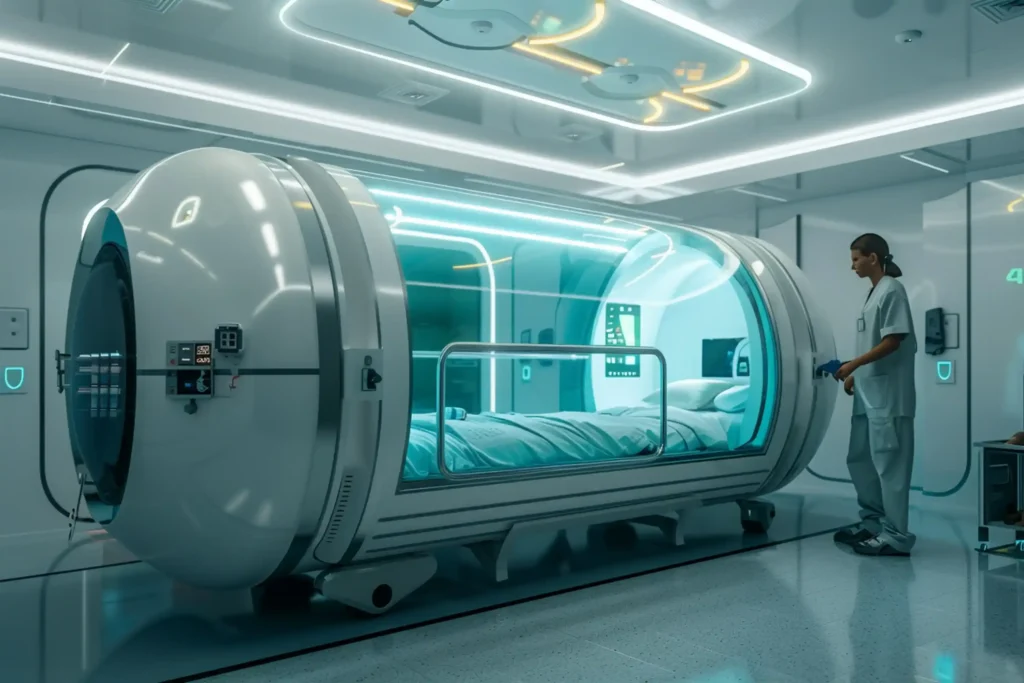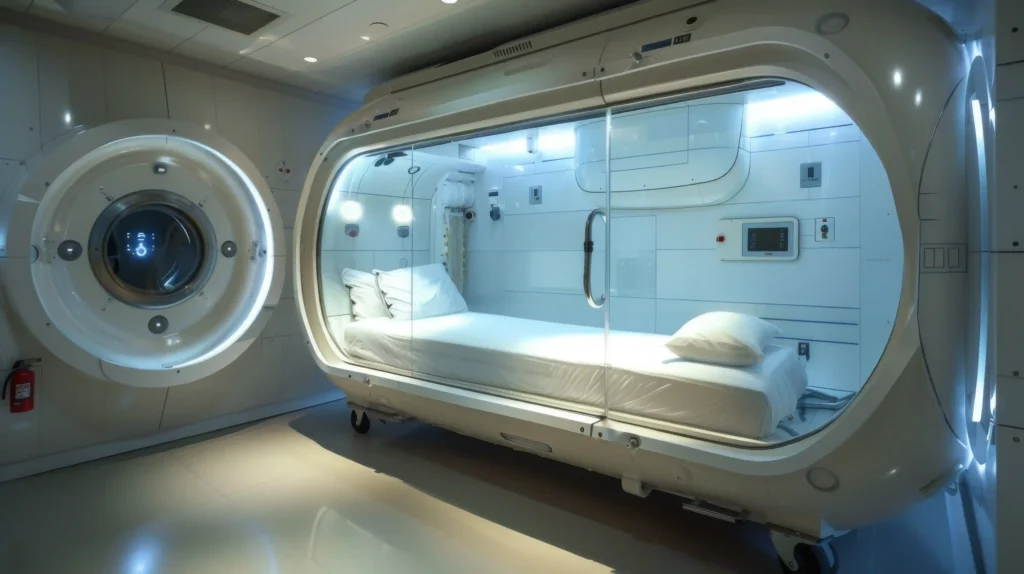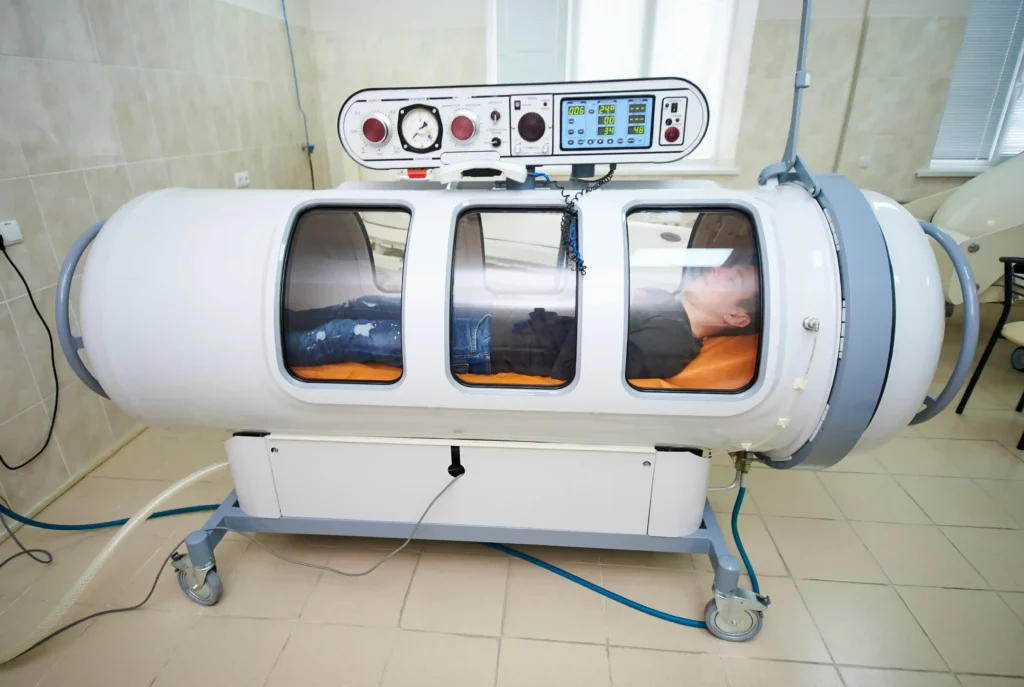

Quick answer: PVHO-1 is the ASME safety standard for pressure vessels for human occupancy. It applies when a chamber holds a person at a pressure difference above 2 psi (15 kPa). So it covers hyperbaric, diving, decompression and altitude chambers. For hyperbaric buyers, understanding PVHO-1 helps you evaluate a chamber’s engineering, structural safety, operating pressure, configuration, and compliance requirements before selecting a manufacturer or system.
PVHO-1 shows up on almost every hyperbaric spec sheet, but it’s rarely explained. Few buyers know what it really asks for, though, or how to check that a chamber meets it. So this guide explains the standard in simple words, without the code-book language.
What Is ASME PVHO-1?
ASME PVHO-1 is a safety standard published by the American Society of Mechanical Engineers that sets mandatory rules for the design, fabrication, inspection, testing, marking, and certification of Pressure Vessels for Human Occupancy (PVHO). Moreover, ASME formed the PVHO safety committee in 1974, and the first edition then came out in 1977.
What does PVHO mean?
PVHO stands for “pressure vessel for human occupancy.” In other words, it’s any pressure vessel with a person inside its pressure boundary. So a hyperbaric chamber is one type, while diving bells, submersibles and personnel transfer capsules are others.
Who writes the ASME PVHO-1 standard?
Basically, a volunteer ASME committee of engineers, makers, users and regulators writes it. Then that committee splits the work among subcommittees for design and piping, general requirements, medical hyperbaric systems, diving systems, submersibles, viewports and post-construction. There’s also a task group on tunneling.
What is the current edition?
The current ASME PVHO-1 code is the 2023 edition, published on December 11, 2023, and it runs 209 pages. Meanwhile, its companion, ASME PVHO-2, covers chambers once they’re in service.
What Does the PVHO-1 Standard Cover?
Specifically, the standard sets rules for the design, fabrication, inspection, testing, marking and stamping of each vessel. It also covers the piping systems that serve it.
The pressure boundary
At its heart, though, is the pressure boundary, the part of the chamber that holds pressure. According to the scope, that boundary also includes:
- Shells and flat heads
- Openings, nozzles and penetrations
- Quick-acting closures and access openings, such as doors and locks
- Attachments and supports
- Viewports
- Pressure relief devices
The boundary then ends at the first weld, threaded joint or flange face on each connection. After that point, the piping rules take over.
How the code is organized
Section | Topic |
Section 1 | General requirements, including design, materials, welds and testing |
Section 2 | Viewports, mainly acrylic windows |
Section 3 | Quality assurance for PVHO manufacturers |
Section 4 | Piping systems |
Section 5 | Medical hyperbaric systems |
Section 6 | Diving systems |
Section 7 | Submersibles |
So a medical hyperbaric chamber draws on the general rules, plus the viewport, piping and medical sections.
Which Chambers Need PVHO-1?
The rules kick in once the pressure difference passes 2 psi, or 15 kPa. That also works both ways: higher pressure inside, as in a hyperbaric chamber, or lower pressure inside, as in an altitude chamber.
Chambers inside the scope
First, the standard lists submersibles, diving bells and personnel transfer capsules. It also names decompression, recompression, hypobaric and hyperbaric chambers. So in practice, that covers:
- Monoplace and multiplace medical hyperbaric chambers
- Diving and recompression chambers
- Research chambers that hold people
- Hypobaric or altitude chambers
- Tunnel man locks and medical locks
On that last point, OSHA also said in a 2010 interpretation letter that PVHOs on tunnel boring machines must follow the standard.
What about soft-shell chambers?
Some online guides claim soft-shell chambers sit below the 2 psi line. But that’s not right. A 1.3 ATA soft-shell chamber runs at about 4.4 psi above room pressure, so it’s well inside the scope. In fact, the standard even has code cases for vessels made from flexible materials such as reinforced fabrics. Still, many consumer soft-shell units aren’t built or documented to it.
How PVHO-1 Relates to ASME Section VIII
Still, the standard doesn’t replace the general pressure vessel code. Instead, it builds on it. For instance, steel vessels still follow ASME Boiler and Pressure Vessel Code Section VIII, Division 1 or 2. So they carry an ASME “U” or “U2” mark and the matching data report.
Then the human-occupancy rules add what Section VIII doesn’t address for people inside. First, its early editions added rules for pressure relief devices and viewports. Then later editions added acrylic window design and integral piping systems. In short, Section VIII keeps the vessel intact, while PVHO-1 makes it safe to sit in.
Key ASME PVHO-1 Requirements for Hyperbaric Chambers
So here’s what the ASME PVHO-1 requirements mean for a hyperbaric chamber in practice.
Design pressure and operating pressure
First, every PVHO starts with a User’s Design Specification. That document sets the design pressure, temperature, size and use, so everything else follows from it. Then engineers size the shell, heads and openings to that design pressure, which sits above the working pressure. For instance, our clinical multiplace chambers carry a 6 ATA working pressure rating.
Materials and welds
Materials must be approved and traceable, so you can trace each plate back to its source. Welds and welders must also be qualified, and welds get examined during fabrication.
Viewports
Acrylic windows get their own section, because acrylic behaves very differently from steel. As a result, each window has a defined design life, pressure rating and temperature limit. Each one is also pressure tested and certified before use.
Penetrations, locks and doors
Also, every hole in the shell, whether for pipes, wires or doors, is part of the pressure boundary. Therefore, each one must be designed, reinforced and tested like the shell itself.
Piping systems
Next, Section 4 covers the piping that carries air, oxygen and other gases into and out of the chamber. That also includes valves, gauges, hoses and connections.
Medical hyperbaric systems
Section 5 then adds rules for clinical chambers, such as controls, gas supply and safety systems.
Testing and quality assurance
Finally, each completed PVHO is pressure tested before use. Also, Section 3 requires the maker to run a quality assurance program.
Want proof, not just a “PVHO-1 compliant” label?
After all, we hand over a full set of code papers with every chamber we build or recertify. So when you’re comparing chambers, talk to our engineers about what each document shows and how to read it.
ASME PVHO-1 Certification: What Paperwork Proves Compliance?
A “compliant” label on a brochure means little by itself, because real ASME PVHO-1 certification shows up in documents. A complete package usually includes the following:
Document | What it shows |
Section VIII data report (Form U-1A or U-2A) | The vessel meets the general pressure vessel code |
PVHO-1 Form GR-1 | The manufacturer’s data report for the PVHO |
Form VP-1 | Fabrication certification for each acrylic window |
Form VP-2 | Design certification for each window |
Form VP-3 | Certification from the acrylic material maker |
Form VP-4 | Material test results for the acrylic lot |
Form VP-5 | Pressure test certification for each window |
Nameplate and stamping | Permanent marking tied to the data reports |
Installation, operation and maintenance manuals | How to install and run the system safely |
In fact, some states even write these documents into law. For instance, Hawaii’s rules require PVHO systems to follow the standard, and they list the GR-1 and VP forms. They also allow makers to register the paperwork with the National Board of Boiler and Pressure Vessel Inspectors.
PVHO-1 vs PVHO-2
The build standard governs how a chamber is made. ASME PVHO-2, on the other hand, covers what happens after it goes into service. That includes routine checks, viewport inspections and repairs, too.
For instance, PVHO-2 has its own viewport inspection form. A UHMS guide also advises owners to keep each window’s original papers for its service life, plus one year. So when you buy a used chamber, ask for those files as well. Meanwhile, our recertification work follows both standards, including PVHO-2 window and seal service.
How PVHO-1 Fits With Other Hyperbaric Chamber Standards
Still, PVHO-1 is only one piece of the puzzle. In fact, a clinical hyperbaric chamber usually answers to several standards at once:
Standard | What it covers |
ASME PVHO-1 | The vessel, viewports and piping for people inside |
ASME Section VIII, Div. 1 or 2 | General pressure vessel construction |
ASME PVHO-2 | In-service inspection and repair |
NFPA 99, Chapter 14 | Fire safety for hyperbaric facilities |
FDA 21 CFR 868.5470 and 510(k) | Medical device clearance for clinical chambers |
IEC 60601-1 | Basic safety of medical electrical equipment |
FDA 21 CFR Part 820 | Quality system rules for device makers |
OSHA 29 CFR 1910 Subpart T and 1926.803 | Diving and tunneling chambers at work sites |
Also notice that ASME PVHO-1 compliance and FDA clearance are separate. So a chamber can meet the standard and still lack FDA clearance for medical use, or the other way around. Still, the FDA does recognize it as a consensus standard.
Why PVHO-1 Matters to Buyers
The standard isn’t just paperwork, though. So here’s why it counts:
- Safety: It addresses risks Section VIII alone doesn’t, like acrylic windows and the repeated pressure cycles that come with daily use.
- Approvals: Fire marshals, state inspectors and accreditation surveyors also often ask for these papers.
- Lifespan and resale: A chamber with full papers can be inspected and recertified for decades, while one without them often can’t.
- Real-world stakes: In 2024, the US Coast Guard’s investigation into the 2023 Titan submersible loss heard expert testimony that compared its design with PVHO-1. That case shows what can happen when a human-occupied vessel skips the code.
How to Verify PVHO-1 Compliance: A Buyer’s Checklist
Before you buy, ask the seller for these items:
- The Section VIII data report, as well as Form GR-1.
- Forms VP-1 through VP-5, too, for every acrylic window.
- A photo of the nameplate and stamping, so you can match it to the papers.
- The design pressure, working pressure and design temperature.
- Proof of the maker’s quality system, such as ISO 9001 or ISO 13485.
- The FDA 510(k) number, when you’ll use it as a medical device.
- A PVHO-2 inspection plan, plus the operating manuals.
If a seller can’t produce these, then treat “compliant” as a claim, not a fact. For the classes and types these documents apply to, also see our guide to types of hyperbaric chambers.
How PCCI Applies the PVHO-1 Standard
Every PCCI pressure vessel follows ASME Section VIII, Division 1, and every patient vessel also follows PVHO-1. Also, our multiplace chambers include NFPA 99 fire suppression. On top of that, we work under an ISO 9001:2015 quality system, and our clinical chambers carry FDA 510(k) clearance.
Ramesh Dixit, PE, our division head, also chairs the PVHO tunneling group. He also serves on the piping and design, general requirements, medical systems, post-construction, diving and viewport subcommittees. So the standard isn’t just something we follow. Instead, it’s something we help shape.
Frequently Asked Questions
Is PVHO-1 required by law?
It depends on where and how the chamber is used. For instance, some states, like Hawaii, write the standard into their rules. OSHA has also applied it to tunneling chambers, while NFPA 99 points to it for hyperbaric facilities. Even where it isn’t law, though, fire officials and accreditation bodies often expect those papers.
Is PVHO-1 the same as FDA clearance?
No, because the build standard covers how the pressure vessel is designed, built and tested. FDA 510(k) clearance, by contrast, covers whether a chamber can be marketed as a medical device for specific uses. A clinical chamber should have both, so ask for the GR-1 data report and the 510(k) number.
Do soft-shell chambers need to meet PVHO-1?
They fall within its scope, because a 1.3 ATA soft-shell chamber runs at about 4.4 psi above room pressure. The standard also has code cases for flexible materials. However, many consumer soft-shell units aren’t built or documented to the standard, so always ask for proof.
What is the difference between PVHO-1 and PVHO-2?
First, PVHO-1 covers how a chamber is designed, built, tested and stamped. PVHO-2, on the other hand, covers in-service care, such as routine inspections, viewport checks and repairs. So together, they cover a chamber’s whole life, from the shop floor to its final year of use.
How do I check if a hyperbaric chamber is PVHO-1 certified?
First, ask for Form GR-1, the Section VIII data report, and Forms VP-1 to VP-5 for each window. Then check that the nameplate matches the papers. If documents are missing or vague, then treat the claim with caution until the maker can prove it.